Allan Nguyen, Association Montessori Internationale, February 2026
««««««« Download the full paper in PDF »»»»»»»»»
Abstract
In adult organizations, hierarchical images, concepts, and terminology influence the way we speak about work, how accountability is assigned, how disagreement is handled, and even how respect is understood and expressed. And that is even true in mission-driven organizations where we can still hear hierarchical patterns, such as: decisions travel “up”, responsibilities are concentrated in a few people, and the organization becomes vulnerable when there is a leadership transition. In a confidential report I read recently about challenges in an organization, the author named “continued reliance on a single point of power and control” as a structural weakness that may have been one explanation for their current struggles. (Author, 2026).
In this paper, I propose a Montessori-informed reframing of the organizational imaginary. For that, I take inspiration from the concept of interdependence as expressed in Montessori’s cosmic vision. This leads to a mission-centered geometric representation of organizations, replacing pyramids and vertical representations. Patterns are presented as concentric circles and mandala-like shapes, where the mission and the values are the true centers. Each circle represents a domain of responsibility rather than a level of superiority. In this framework, authority is understood as stewardship in relation to purpose. Coordination is a matter of relationship, role clarity, and prepared conditions.
The concept of responsibility then extends the model into a developmental thread, as it shows connections across cosmic, social, and individual levels of work and reflects on how responsibility can grow from independence toward interdependence, and how sustainability in organizations depends on the gradual redistribution of responsibility aligned with the shared mission and values.
This reflection is based on my experiences in educational but also non-educational organizations, interviews with practitioners, interviews with people active in leadership roles, and I attempt connections with important thinkers outside the Montessori tradition.
Table of Contents
- 1. Why rethink organizations through interdependence.
- 2. Sources and method: experiences, literature and interviews.
- 3. Interdependence as a living systems perspective.
- 4. The Montessori Interdependency Model in Organizations.
- 5. Responsibility: Linking Cosmic Vision, Development, and Leadership.
- 6. Conditions that allow interdependence to appear.
- 7. Authority, limits, and dignity: the responsibility to protect.
- 8. Montessori “trios” translated for adult organizations.
- 9. Governance, ownership, and the shareholder challenge.
- 10. Mini-centers, divisions, and inter-organizational interdependence.
- 11. Visual language and the psychology of forms.
- 12. Discussion: strengths and limits.
- 13. Conclusion: Responsibility and Interdependence in Organizations.
- References.
1. Why rethink organizations through interdependence
Everyday phrases such as “escalate,” “sign off,” or “get buy-in” creep into our communications. They still organize attention, relationships, and responsibility. Unconsciously, this shapes what people think, what they dare to do, what they learn to wait for, and how they take initiative, or not. With time, this becomes fatigue, recurring conflicts around authority, disengagement, dependency on a few strong personalities, and, more importantly, fragility during leadership transitions or difficult times.
When thinking about this, Montessori’s thought appears to me as an opportunity for a change of perspective. Her view of the world, and how she presents it to both adults and children, is called the cosmic vision. It is about a world held together by interdependence, a set of natural laws, and a concept of cosmic task that could be translated into the idea of responsibility.
Around the age of 6 to 12 years old, the child is presented with this cosmic vision, with what Montessori calls cosmic education, through stories, charts, presentations, materials, and even through the way classroom life is lived. It frames the meaning of work, the dignity of contribution, and the ethical horizon of freedom. In this paper, I attempt to take that lens and ask a practical adult question: What would organizational leadership look like if we treated interdependence as a real philosophy of work, replacing a long tradition of hierarchical systems of power?
Purpose and positioning
My aim is to offer a possible bridge between Montessori’s cosmic vision and adult organizational life, both for Montessori and non-Montessori readers. To start, maybe, a conversation. I have worked in schools, associations, boards, and non-educational organizations, and I try here to connect these experiences with the help of some colleagues and friends who helped me shape a beginning of an idea. Something to make visible a set of principles and conditions that can help adults organize themselves around collective missions and values with more clarity, agency, and sustainability.
A note on examples, naming, and ethics
As I’ll be sharing some examples, you will note that some of them will be anonymous, especially when they illustrate ineffective or harmful hierarchical dynamics. In those cases, I invite you to recognize patterns and consequences, but not judge characters and people.
Here is the question that will support my reflections throughout this paper: what conditions invite adults to take responsibility in relation to mission, and what conditions train adults to defer responsibility “upward”?
2. Sources and method: experiences, literature and interviews
I am not attempting here to prove a model through a scientific method, control comparisons, or any systematic method. This is intended as a reflection bridging personal experiences, Montessori and non-Montessori literature, and interviews with active leaders. In my efforts to build a coherent conceptual bridge, I am hoping it will help you see structure, responsibility, and development in organizations with a new eye.
There are two interviews that helped me shape many ideas. I used them as reflective mirrors of practice. The interviews are with Michaël Veilleux and Janick Dumas, both of whom participated in the Montessori Core Principles course in Paris in 2025. Michaël speaks from the perspective of an entrepreneur and organizational leader, while Janick speaks from the perspective of school leadership in Quebec. In both cases, I initiated the conversation after they told me about the way Montessori language and images helped them name what they were already trying to do in their leadership roles.
3. Interdependence as a living systems perspective
3.1 Key terms and concepts
A few terms need stable meaning before we move further.
- Interdependence (Montessori sense). Interdependence names a fact of life. Living beings exist through relationships: with materials, ecosystems, human communities, and the accumulated work of other actors across time. In Montessori’s cosmic vision, survival is always tied to contribution within this web of relationships. For her, independence can never be only seen as “what can I do by myself?” It is also “what can I contribute, and what responsibilities emerge because others depend on my work?”
- Independence. Independence is a developmental achievement. It is the growing capacity to act with skill and self-direction, following inner drives. In Montessori, independence is not about isolation. It is the condition that makes interdependence possible without force or assimilation.
- Responsibility. Responsibility is treated here as a linking thread between individual development, social organization, and mission. It is not only accountability after the fact, as we tend to understand it today. It is about the capacity to respond, to carry consequences, and to choose my contribution in relation to a larger purpose.
- Conditions and prepared environment. Action and behavior are shaped by conditions. The prepared environment is a set of physical, social, and procedural conditions designed to support purposeful activity and the growth of responsibility. I will defend here that in organizational life, a “prepared environment” includes diverse aspects such as role clarity, decision rights, information flow, language norms, and how mistakes are treated. Leadership work then consists in the intentional preparation of these conditions.
- Mission and values. Mission is the shared purpose that gives coherence to action, and creates engagement. It is built according to a vision. Values express the ethical qualities the members of an organization agree to embody while pursuing that purpose. In this paper, I treat mission as a real organizing center. When mission functions as an actual center of gravity, it can coordinate distributed responsibility without requiring the use of power and control.
3.2 From hierarchy to systemic thinking
We know today how language shapes intelligence, but it also shapes behavior. And this is true for our organizations. The vocabulary we use trains us and influences our mindset. Vertical or hierarchical language does more than describe structure. It actually teaches people where value sits, where decisions belong, and what kind of initiative is allowed. We all have our own internal storytelling, filled with phrases like “getting approval,” “my boss won’t like that,” or “it’s my job.” It becomes our internal map. And that’s how we begin to interpret problems through position, rather than through purpose.
In an internal organizational reflection that I’ve been invited to read, the author named this shift like this: “centralized authority can blur the line between collaboration and control” (Author, 2026). Think about how power, when concentrated, can move relationships from shared work toward power dynamics. I can see myself shift toward that kind of mindset when I am in a context like this. I start to perceive things vertically, see myself in isolation, and resent others for what I believe they should do differently. That is when the horizontal craft of working together with peers starts to weaken. We point fingers and look for culprits. That’s when collaboration becomes less about the mission and more about navigating power systems.
Montessori’s cosmic vision offers a very different framework. Contribution becomes what shapes relationship instead of power. In nature, for example, size, intelligence, or power doesn’t define the importance of your contribution. Think about how essential phytoplankton are in being the main providers of oxygen on Earth, while they are among the smallest living creatures on our planet. If we look at organizations as living systems or living ecosystems of roles and responsibilities connected by a shared purpose, then we can start making connections with the cosmic perspective. Authority can be seen as being accountable to conditions that support everyone’s contribution. Later, I will return with some visual forms to help us create images and spatial metaphors to support that shift.
These kinds of perspectives aren’t new in the organizational leadership world. Laloux’s developmental map for example describes a similar point of view. It’s about how “Vertical” language often carries an implicit theory of human value that moves historically from power and role certainty toward contribution, relationships, and purpose (Laloux, 2014, chap. 1.1 and 1.2).
3.3 The mission as the true center
If we want a true mission-centered geometry, we should start by observing what consequences come from person-centered leadership. I definitely recognize how powerful leadership can produce speed and coherence in the short term, and that may be, or feel, inevitable in moments of urgency. Yet it is structurally fragile. When one person or a small number of people become the center, then the organization’s stability entirely depends those people, on their presence, their energy, and their authority. Maybe the organization can function well, but it’s vulnerable.
A good friend of mine and AMI 3-6 Trainer, Jess Fraley, describes how distributed responsibility can support a mission-centered structure that both respects each person’s dignity and is more sustainable for the organization (Fraley, 2026b). It is about an interdependent articulation of distributed leadership that frames the aim as “shared stewardship,” shifting our attention from position to purpose. In this context, authority becomes tied to the work rather than to status. The mission functions as a gravitational center that coordinates decisions, priorities, and accountability. A person may still hold a role with real authority, yet the authority is justified by proximity to mission and responsibility for conditions, not by superiority or power.
Leadership, then, is redefined as proximity to the center, which is the mission itself rather than an individual or a small group. Real leadership becomes the capacity to interpret purpose, prepare conditions, and sustain shared work and responsibility over time.
4. The Montessori Interdependency Model in Organizations
I argued in the previous section that interdependence is a way of seeing and a way of structuring work. I will attempt now to give the model a visible organizational form.
4.1 Concentric Circles and Domains of Responsibility
The first move is to replace levels with domains. Circles better represent responsibility held in relation to mission and values (the center), with different kinds of work requiring different kinds of authority, competence, and time.
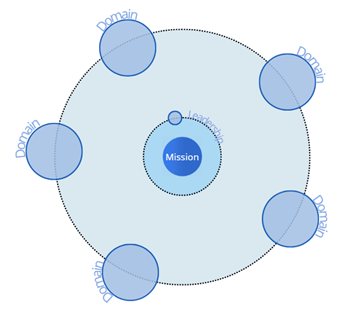
Fig. 1: Domains are positioned by relationship to mission, not superiority.
A domain is defined by the nature of decisions that belong there, the information needed to make those decisions, and the consequences of acting or delaying. This reframes leadership from “who is above” to “who carries which responsibility for the mission, and with whom they must coordinate.”
In a leadership proposal, Fraley articulates a view of adults as capable of self-management “within interdependent relationships if the structure supports that way of working,” shifting the focus from positionality to the structural conditions that support responsibility (Fraley, 2026a). This is a strong alignment with Montessori: adults do not become responsible because a leader demands it, but they become responsible as the environment makes responsible action possible, meaningful, and expected according to the individual’s or the team’s domain.
In the kind of time-sensitive interdependent work we find in modern organizations, centralized power structures create delays that aren’t linked to actual necessity. When decisions must travel to a single point of control, domains begin to “queue” behind one another. Work that depends on timely coordination becomes fragile, and energy shifts toward waiting, persuading, or protecting oneself against being blamed for delays (Author, 2026). In the interdependent model, decisions are intentionally circling around the actual work, preventing bottlenecks where multiple domains depend on timely coordination.
How? Within a domain, collaboration is horizontal: peers coordinating, refining, adjusting, and learning together. Cross-domain connection becomes necessary when mission coherence is at stake, or when a decision in one domain affects another. This is where the concept of concentric circles comes in: leadership is represented by a circle closer to the center, the mission. Other circles, representing domains, gravitate around it while circling around their own domain-related mission. Leadership roles are then guardians and communicators of the shared center.
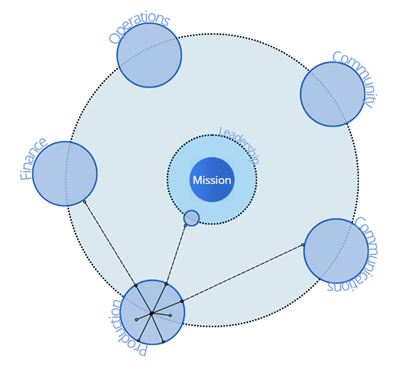
Fig. 2: Solid line = within-domain coordination; dotted line = consult when consequences cross domains or requires alignment with mission.
A practical mechanism that makes this distribution workable is Laloux’s advice process. A decision does not belong exclusively to a role at the top, and it does not require consensus from everyone. Instead, a person makes the decision after seeking advice from those affected and those with expertise (Laloux, 2014, chap. 2.3). In the circles model, this keeps decisions close to the work while making consultation obligations explicit.
“We often think that decisions can be made in only two general ways: either through hierarchical authority (someone calls the shots; many people might be frustrated, but at least things get done) or through consensus (everyone gets a say, but it’s often frustratingly slow and sometimes things get bogged down because no consensus can be reached). The advice process transcends this opposition beautifully: the agony of putting all decisions to consensus is avoided, and yet everybody with a stake has been given a voice; people have the freedom to seize opportunities and make decisions and yet must take into account other people’s voices.”
(Laloux, 2014, chap. 2.3)
In Montessori terms, this resembles an adult form of freedom and responsibility held together by a prepared social environment. Initiative is permitted within a domain; there is freedom. There is also responsibility, because consultation is required, consequences are owned, and the decision is carried through with attention to mission and coherence across domains.
4.2 A mandala rather than a pyramid
As I was saying earlier, geometric representations allow our brains to interpret realities on another level. They create support for our imagination in a similar way that we use impressionistic charts to support the work of the imagination of the 6 to 12 child. And when we look at images describing traditional organizational leadership models, we usually see pyramids and other vertical representations. And pyramids teach a specific kind of attention: up and down, above and below, higher and lower. They generate corresponding vocabulary that supports a mindset of power dynamics. It shapes our expectations.
I’ve always been fascinated by mandalas, and I believe they could help us ask different kinds of questions in terms of organizational leadership. With a more relational geometry, they suggest balance, differentiation, and relationships more than hierarchy. They invite us to ask questions such as “how do these parts hold together?” Rather than, “who is in charge of whom?”
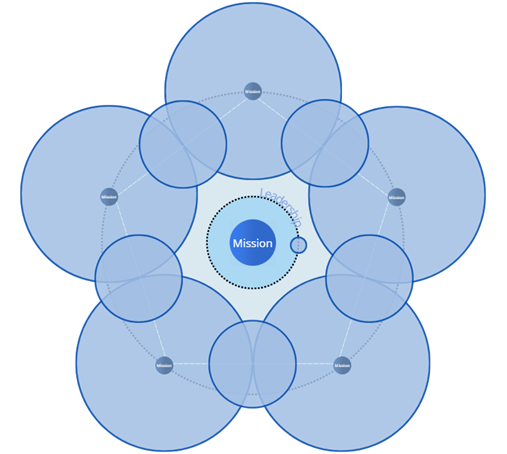
Fig. 3: A form that trains attention toward balance, differentiation, relationship.
It is important because human organizations have always been carried by symbols and images. Think about how flags united whole peoples, sometimes diverse groups. And the symbols we use, and the shapes, they affect what we perceive as our values, what we think is possible, and what we do when we are under pressure. I see mandalas as forms that could function as cultural support for interdependence because they represent coordination, equilibrium between domains without implying any kind of hierarchy; without having any circle being above another one.
The “teal” framing, explained by Laloux, often uses living-systems imagery to describe organizations as relational and purpose-oriented rather than stacked levels of control (Laloux, 2014). The mandala-like forms I am proposing act as psychological supports for an interdependent mindset, in particular when complexity needs coordination across domains (Laloux, 2014).
4.3 Language as structure
You may have noticed that as we consider a different form, language automatically starts to shift too. Because it is not decoration, it is how we make structure, how we bring structure into our abstract understanding. And it also allows us to communicate about the structure in a way that aligns with an interdependent mindset. Because it leads us to use mission-oriented verbs and nouns, it trains us with different reflexes by returning decisions to purpose, responsibility, and to the conditions that actually support interdependent decisions.
Here are some examples of phrases that re-center the mission inside everyday decision-making:
- “Which part of the mission is at stake here?”
- “Who is most impacted by this decision?”
- “Which domain holds this responsibility, and who needs to be consulted?”
- “What condition is missing that would make responsible action easier next time?”
- “How are our missions aligning?”
These shifts also reduce bias risks. In a person-centered culture, the story of competence can become tied to visibility, charisma, proximity to power, or similarity to the leader. In a mission-centered culture, competence is named in relation to contribution, reliability, and the ability to coordinate responsibly with others. Language is one of the simplest ways to make that shift concrete.
Transitioning from a person-centered to a mission-centered culture also changes how we understand competence. In traditional organizations, because they are person-centered cultures, visibility as a consequence of charisma and proximity to power tends to be seen as a sign of competence or even success. It creates biases because we then start allowing personality and position to be what matters most for us and what we recognize as competence instead of contribution.
But in mission-centered cultures, we see competence through the work itself. We recognize it when we see concrete contribution to the mission, reliability in carrying responsibility, and also the ability to coordinate responsibly with other domains and other people. Visibility and status then become secondary to alignment with purpose. And for that shift, again, language plays a structural role. Think about how an organization speaks about performance and leadership. Does it reinforce personal hierarchy, or does it redirect attention toward the shared purpose, the work, and the collaboration?
Janick Dumas, in her interview, offered me an image that I think fits very well with this framework. She talks about the leader as being a “chef d’orchestre”, a conductor (Dumas, 2026). We know that the conductor cannot create music without the musicians and that the contribution of the musicians is essential for the piece. But the function of the conductor is real. It is about holding the tempo, supporting coherence and harmony, recognizing competencies, and making contribution possible through coordination and the understanding of the piece that we are playing together. I think this image is important to keep one truth in our minds. Interdependence does not mean everyone does the same thing. It means that different responsibilities are held together by the shared center so that they serve the shared work.
Now that we’ve seen the structure take form and have defined a language for it, we will explore the thread that gives this framework ethical and developmental coherence, and that is responsibility.
5. Responsibility: Linking Cosmic Vision, Development, and Leadership
5.1 Responsibility at three levels: cosmic, social, individual
For Montessori, responsibility in human work is about conscious contribution within a larger whole, with awareness of consequences through the understanding of the world as an interdependent system. In that cosmic perspective, every being, even in nature, contributes to interdependence, but humans are unique in their capacity to assume this contribution intentionally.
Similarly, she talks about responsibility in human development as something that grows with independence, something that matures with independence practiced in community in a shared environment.
Here, we can see how this could apply to organizations, as leadership can be seen as the work of creating conditions where agency is possible, where roles and accountability always stay linked with the mission and the values, the shared mission and values. This way, responsibility is lived throughout the organization rather than being concentrated at the top of a pyramid.
In short:
- At the cosmic level, responsibility is about recognizing that consequences extend beyond the self. Contribution is not neutral, as every action has an effect, even when the effect is indirect or delayed. Responsibility for water is to follow the laws of physics and chemistry so that it can play its role in the ecosystem, for example, in realizing the water cycle. For plants, responsibility is about following the laws of their species to survive, but also to contribute to harmony in the ecosystem where they live by creating food and interacting with other agents, like animals, to serve the community. And for human beings, it is about conscious participation in this balance.
- At the developmental level, responsibility grows with independence. First, the child needs the capacity to act, to choose, to think, and gradually this becomes active in relation to others. Independence is not an end in itself. It is a requirement to allow their contribution, which leads to responsibility. Without independence, responsibility ends up collapsing into obedience or fear.
- At the organizational level, responsibility becomes the relationship between the work and the center. We find it where the work is meaningful, where consequences are felt and understood, and where coordination is indispensable. In a mission-centered geometry, a person or a role carries responsibility because the mission requires it, not because a person requires it. It creates the clarity that allows the distribution of responsibility.
5.2 Responsibility as an inner posture, then a function
There is an inner dimension of responsibility, something that has more to do with mindset than knowledge. In her interview, Janick emphasized that responsibility requires self-observation and self-regulation. It requires us to move from reaction to action, and it requires us to remember that change takes time. She also mentions the importance of safety within a team, because responsibility cannot mature where people feel threatened, shamed, or constantly under evaluation (Dumas, 2026).
I have seen organizations trying to “install” responsibility by adding rules, accountability tools, or even performance pressure. These tools are based on external motivators in the shape of what Montessori calls, in traditional education, punishments and rewards.
When true responsibility grows through moments where a person can experience and notice themselves, they gain the possibility of choosing a response that serves the work and the mission. This inner movement does not occur in isolation. It depends on conditions that make reflection possible rather than reactive. For that to happen, teams need a safe space for exploration, a place where experimentation is valued and mistakes are understood as part of growth. A prepared environment in the Montessori sense is therefore not only about the physical setting. It is about structuring relational and organizational conditions that allow self-observation, dialogue, and adjustment to take place without fear. When such conditions are present, inner awareness can translate into self-directed action that aligns with the shared purpose
In a system like that, with time, responsibility becomes visible in how someone carries a role, how they hold commitments, how they consult others, how they repair after mistakes, and how they return decisions to the mission. That’s where this inner posture supports the work.
5.3 Responsibility and integrity as conditions of a living system
Responsibility in a living system depends on trust, and trust depends on integrity. In his interview (Veilleux, 2026), Michaël defines integrity like this:
- Integrity is a condition in which a system is whole in the way it functions: all the necessary parts are present and coherent in relation to the whole, without internal contradiction. When they operate like this, he considers the system high in integrity. This implies that when one part is missing, altered, hidden, or distorted, integrity is weakened, which can reduce performance and create instability over time. Integrity is therefore not only a moral quality, but an observable, structural, and functional property: it is the condition by which something can function, sustain itself, and produce reliable effects through time. In his organizational model, integrity is closely tied to the dynamic interplay between clarity, affinity, and synergy: if one collapses, the others are affected, and an imbalance appears. Therefore, integrity for Michaël is about integrating principles and the expression of their harmony, in its effects and over time.
In the context of an organization, that means that the system is high in integrity when the different actors, domains, and human relationships can express themselves fully and coordination. In our interdependency model, integrity is then mission-coherence made visible.
We can recognize it when decisions match the collective purpose, when promises can be relied on. We can also see it when relational practice is open, honest, and doesn’t feel the need to manipulate or hide. In other words, integrity allows people to make decisions closer to the work. We can assume that others will do what they say, communicate when they cannot, and repair when necessary. Therefore, distributed responsibility requires integrity. Without it, the risk is high that people will respond by recentralizing control.
A different problem can occur when there is participation, but no agency. As an example, when I was participating on a parent committee in a public secondary school in Quebec City, I remember how the administrative leadership still retained all of the executive authority while the committee functioned in a consultative role. Conversations were thoughtful and sincere, but without decision-making power in relation to the mission, responsibility did not deepen. We kept our engagement at a surface level. With time, disengagement came. When we don’t feel that our contribution shapes the organization and shapes the direction, then ownership cannot consolidate. This shows how interdependence requires entrusted authority. An opposite experience was when I was working at a local federal elections office. Quickly, as leadership recognized my capacities, I was offered new responsibilities accompanied by real agency. The framework was clear, and I knew what decisions I could make within clearly defined parameters. For me, the effect was immediate. I engaged deeply, I felt entrusted enough to take initiative, and I built a strong sense of ownership naturally. In this experience, responsibility felt real and not symbolic. It felt consequential. That shows how agency, when it is aligned with trust, creates a higher level of responsibility.
5.4 Responsibility and Structural Sustainability
Another important thing that I learned through my experience is how the way you create an actual interdependent sense of responsibility can support structural sustainability. And how, on the contrary, when responsibility is held by one person and only distributed through control, this threatens that same sustainability.
That became clear to me through an unfortunate experience I had with the Fondation Montessori de Québec during my years on the board and especially while serving as president. Much of the organization’s activity became tightly tied to my initiative. I carried several projects, coordinated the team, and often served as the interpretive center of direction. The work was aligned with a mission that was clear in my head and animated by a commitment that was organized by myself. During these years, activities were flourishing, and there was visible progress.
Unfortunately, the way I distributed responsibility did not outlive my time. The mission was present, but the operational coherence was mostly held by me. After my departure, several mission-oriented activities slowed or even ceased. It was not due to indifference or lack of skills among the team. For me, this revealed that responsibility had not been structurally redistributed. It was still tied to my leadership. What had been sustained by dedication had not yet become sustainable by design.
In a person-oriented configuration, responsibility circles around personal motivation, charisma, or individual skills. In a mission-centered configuration, responsibility is gradually differentiated and shared in such a way that no single individual becomes the axis of continuity. Interdependence, therefore, becomes the structure of sustainability.
There is an interesting parallel to make with human development and education. In Montessori environments, the adult prepares conditions so that the children can act independently, following their inner drives and motivations. When the adult remains the source of motivation and order in a classroom, we know the environment is not yet fully conducive to normal development, because the external structure that the adult imposes does not allow for the expression of the true self of the child. In a similar way, when an organization depends on one person to maintain coherence, this is a sign that interdependence has not yet come to structural maturity.
We see again the linking role of responsibility. When the mission is clear and becomes the reference point for everyone, individuals can act without destabilizing the whole. This structural sustainability is achieved, therefore, by clarifying and distributing responsibility in relation to the common purpose.
6. Conditions that allow interdependence to appear
In this section, I reflect on the conditions required to create this interdependent mindset in an organization. Most organizations I know, gravitating around Montessori, have the intention of working collaboratively and in an interdependent way, but sometimes lack the understanding of the conditions that allow this interdependence to become a reality. There are three conditions that I discuss in this section: the quality of independence, the climate that supports growth, and the clarity of roles.
6.1 Quality of Independence: isolation vs contribution
Independence can develop in two very different directions:
- Independence in isolation is the capacity to function alone, to protect one’s work from interference and to reduce reliance on others. Information stays private, decisions are made with minimal consultation, and coordination is understood as a cost. In an organization, this type of independence leads to fragmentation. We value autonomy, yet the whole becomes harder to align.
- Contributive independence also values competence and self-direction, but in an open way. It is the capacity to act, decide, and understand, but in relationship with others and with the shared purpose. It is a kind of independence that is in communication and in collaboration. It actively and spontaneously consults when consequences cross into other domains and when alignment with the collective mission is uncertain. We can recognize it when it holds responsibility without the need for possessive control.
This distinction matters because many organizations aim for “autonomy” and end up cultivating isolation. People are given freedom without relational obligations. The result is often polite distance or parallel work. Contributive independence, by contrast, makes interdependence possible because it carries a built-in orientation toward the whole. It supports a form of autonomy that participates.
Understanding this distinction is essential for organizations to avoid cultivating isolation. This is the same kind of balance we talk about in education between freedom and responsibility. Two sides of the same coin; two concept that are interdependent.
This is something that Montessori frames clearly when she describes independence as something that develops so that the person can contribute freely to society, not as something that allows a person to withdraw from it. That tells us how important it is for organizations that want interdependence to develop the contributive kind of independence.
6.2 Climate and psychological safety as developmental conditions
As Brené Brown describes it beautifully in her book Dare to Lead, courage is about vulnerability (Brown, 2018, Introduction). And contributive independence requires courage. It requires us to take risks by putting ourselves out there, naming uncertainty, asking for help, admitting mistakes, and speaking about reality honestly. Janick emphasized this when she pointed to the need for more care and support in leadership, and she describes safety as a condition for vulnerability, courage, and learning within a team. (Dumas, 2026).
In organizations, safety is a condition that allows responsibility to become interior. When fear dominates, people learn to hide, to perform, and to protect themselves. Maybe they still comply, but that is not what responsibility means. When safety is present, people can shift from reaction to action. They can regulate themselves, relate more openly with others, and feel they can repair without the need for blame.
In Laloux’s terms, practices do not land well when the surrounding culture remains organized around competition, control, or performance anxiety (Laloux, 2014, chap. 2.2). A move toward more participative and self-managing ways of working depends on conditions that allow people to take initiative without fear and to speak truthfully about reality, including the reality of failure. This aligns with the Montessori principle that development follows the quality of the environment. If an organization wants interdependence, it must prepare conditions that support the psychological work required to live it.
“When organizations are built not on implicit mechanisms of fear
but on structures and practices that breed trust and responsibility,
extraordinary and unexpected things start to happen.”
(Laloux, 2014, chap. 2.2)
6.3 Role clarity
The emergence of interdependence also requires structure and clarity. Role clarity in particular is a simple, yet essential, relational protection that we need in an organization.
Jess Fraley writes that explicit domains of responsibility can “reduce confusion, depersonalize conflict, and support healthier working relationships” (Fraley, 2026b). This is a structural pathway toward dignity and psychological safety. When people know what they are responsible for, what they can decide, and when they must consult, they have less reason to interpret disagreement as disrespect.
Mission-driven organizations frequently have people with strong goodwill who compensate for vagueness. That is a risk when there is a lack of role clarity. Over time, they become overloaded, and what follows is resentment or withdrawal. This is another reason that clear roles distribute responsibility in a way that is more sustainable.
7. Authority, limits, and dignity: the responsibility to protect
One misconception I’ve heard a lot, both in Montessori education and in organizations, is that interdependence or freedom mean openness without a frame. In reality, both freedom and interdependence require clarity in the system. So the role of the adult in education and the role of leadership in organizations is not to be absent, but to create conditions and a clear framework that allows constructive activity to happen. When the frame is weak, the system will compensate through informal power, avoidance, or sometimes personal control. What we are aiming for is a responsibility-centered organization that requires protection of the mission, of the values, and of the individuals.
7.1 Interdependence requires a clear frame
Therefore, the first question is to understand what structure makes responsible participation possible. It is about order and orientation, a clear frame that names what belongs where, how decisions are made, what consultation is expected, and what behaviors are unacceptable because they damage dignity or safety.
Would you consider a classroom that allows physical violence to be conducive to the creation of an interdependent community? In the same way, in an organization, some boundaries are not negotiable because they protect the human conditions that are required for living together and collaborating. That is one important role of leadership, to intervene when dignity is at stake. I don’t think this is a return to dominance because these are protective actions taken in service of the whole, so that responsibility can remain distributed, which cannot happen when fear leads to self-protection.
7.2 Communication practices that protect dignity
One way of doing this that challenges most of us is how to communicate in a way that protects dignity. When under pressure, we often slip into two kinds of mechanisms: indirectness, passive voice, confrontation in the name of truth, or bluntness that damages relationships. Dignity-protecting communication, or non-violent communication, is what we need to develop. It tells the truth while keeping the person safe.
To be able to raise awareness and understanding of dignity in an organization, we can refer to Donna Hicks’s work on the ten elements of dignity (Hicks, 2018, Chapter 14). It is a very practical approach. People rate, one by one, how well they think different aspects of dignity are respected in their workplace. She then uses the results to guide a group conversation (Hicks, 2018, chap. 14). Through this work, she and her colleague Dave Nicol identify dignity hotspots, such as safety, fairness, or identity. Practical solutions or methods like this allow leadership to review policies and decisions with dignity in mind (Hicks, 2018, chap. 14).
7.3 When a context leads to temporary directivity
If we try to understand organizations through time, it brings us to consider the different degrees of responsibility that a team can hold depending on its maturity and the context. Sometimes, acute instability, safety risks, or severe time pressure lead us to a more directive phase to restore coordination and protect essential work.
Laloux describes an evolutionary culture model where different organizational cultures correspond to historical periods, but also to contextual conditions (Laloux, 2014, chap. 1.2). Organizational styles are named using colors and are paired with states of civilization, but also with specific conditions.
“If we were caught in a civil war with thugs attacking our house,
Impulsive-Red would be the most appropriate paradigm to think and act from so as to defend ourselves. On the other hand, in peaceful times in post-industrial societies,
Red is not as functional as some of the later stages.”
(Laloux, 2014, chap. 1.2)
And he adds the important nuance that later stage does not erase earlier capacities. It includes them and can call on them when circumstances demand it (Laloux, 2014, chap. 1.2).
In the context of the interdependent model of organization, this would mean that temporary directivity can be understood as a protective function taken in service of the whole. Maybe people in crisis need someone to name the frame, reduce the noise, and hold safety and coordination until the system regains stability. But this move has a cost. It comes with a mindset where people may feel reduced, mistrusted, or bypassed. What is lived during a crisis like this becomes part of the team’s learning about responsibility and collaboration.
An interesting nuance that Laloux offers is that in the right framework, there could be processes that remain in place even in crisis situations and maintain focus on collaboration rather than isolation. This process is called the advice process (Laloux, 2014, chap. 2.3), and I will discuss it later in this paper.
This is quite important because a temporary shift like this can easily become a permanent pattern. Centralized rescue can become self-reinforcing when the role becomes overloaded and the organization adapts around that overload. Concentrating responsibility in one role often leads to unsustainable expectations (Author, 2026). With time, the organization begins to expect that central role to absorb all of the complexity of the system, and people protect themselves by deferring decisions back to that central role. Ultimately, that leads the organization to confirm to itself that it needs that centralization because the team has stopped practicing shared responsibility.
Maybe one way to keep ourselves from falling into this trap is for leadership to keep the return path visible, to name the criteria for the temporary shift, and to set a time horizon or review point so that shared decision-making can be restored as soon as the system can hold it. Allowing, after the crisis, for tasks to reopen for participation, return responsibility to domains, and rebuild the relational conditions that sustain interdependence.
8. Montessori “trios” translated for adult organizations
Discussing and reflecting on organizations from a developmental perspective brought me to consider some interesting parallels with similar processes that Maria Montessori describes when she talks about education. I will use two Montessori trios to draw a parallel with organizational development:
- the three levels of obedience and
- the three stages in the spiritual ascent of the work of the adult.
While you read this section, I invite you to consider Laloux’s description of the progression of organizations from power-centered forms toward more purpose-centered and self-managing ways of working (Laloux, 2014, chap. 1.3). Alongside the following Montessori perspectives, it supports the idea that groups organize themselves differently depending on the degree of responsibility they can sustain and on the conditions that support that responsibility.
8.1 Three Levels of Obedience in Education
The word obedience carries heavy cultural baggage, so Montessori’s description of it is often misunderstood. In her writing, true obedience isn’t submission to an external will. It is actually something that develops as a capacity to align action with a purpose recognized as being meaningful (Maria Montessori, 2007a, chap. 25), (Maria Montessori, 2007b, chap. 12). A progression that we could attempt to translate into adult organizational life.
Here are Montessori’s three levels of obedience, with an attempted parallel to adult organizational life:
- Capacity without stable alignment. A person can act and can comply in moments, yet action remains largely driven by impulse, mood, fear, or immediate desire. There may be good intention, yet little inner stability. In organizations, this can show up as inconsistency: bursts of effort followed by withdrawal, or shifting commitments depending on pressure.
- Reliable alignment. A person can follow an external frame and can cooperate reliably when expectations are clear. They can “do their part” and carry responsibilities defined by the system. In organizations, this level is often the functional baseline. Many hierarchies can produce it through incentives, performance pressure, and oversight.
- Inner adhesion. A person chooses alignment because they recognize the value of the environment and the purpose it serves. The action comes from within. In organizations, this appears as strong sense of belonging and self-directed responsibility that remains relational: people consult, coordinate, speak truthfully about reality, and repair without needing surveillance.
While we can’t translate this idea of obedience directly into organization philosophy, we can follow its thread to avoid a common mistake: expecting level 3 behavior while preparing level 2 conditions. Level 3, inner adhesion, cannot be demanded. It emerges where meaning, independence, cohesion, and a prepared social environment support inner adhesion to mission.
8.2 Three Levels of Engagement Toward the Mission
Here is a reinterpretation of these three levels of obedience that may be more aligned with how we can understand adults in an organization. And for that, I will use the term engagement. The three levels of engagement are about the quality of relationship to purpose.
- Intermittent engagement. People contribute when conditions suit them, when energy is high, or when leadership presence is strong. The organization experiences uneven participation, and mission becomes more an idea than a lived reference point.
- Functional reliability. People do their work, meet expectations, and carry responsibilities with competence. This is often the level that traditional hierarchies can sustain effectively through clear roles, evaluation, and external accountability. It produces stability, yet it can remain emotionally and ethically thin. Mission is present, yet often secondary to role completion.
- Inspired engagement. People experience mission as meaningful enough to shape choices, initiative, and learning. They take responsibility that goes beyond task completion. They care about coherence, consequences, and the integrity of the work. This level depends on conditions. Meaning matters. Autonomy matters. Cohesion matters. The prepared environment matters.
I invite you to use this trio to interpret your organization’s level of engagement. You probably hope for inspired engagement, and this could help you identify what conditions are required to allow this level of engagement to emerge in your organization.
8.3 The Spiritual Ascent: Stages of the Adult’s Work
A third trio in Montessori literature describes how the adult’s activity changes “from stage to stage, as in a spiritual ascent,” in response to the child’s development (Maria Montessori, 2007a, chap. 27). To evaluate where children are in their path towards normal development, Montessori uses a developmental indicator, which is the expression of concentration. Before that concentration, the adult may need to be more active, present, and inviting. But once this developmental work happens, that is, concentration, then the adult’s task becomes the art of non-interference, paired with careful observation and timely presentations.
Translated into organizations, the movement can be described in three phases:
- Strong presence to establish conditions and frame. In a new team, a new organization, or a moment of disorganization, leadership presence is needed to prepare conditions: clarity of mission, domains of responsibility, decision pathways, and non-negotiables. In Montessori’s first stage, the adult becomes the “keeper and custodian of the environment” (Maria Montessori, 2007a, chap. 27). Organizationally, the comparable work is environmental: creating order, reliability, and the practical supports that make responsible action possible.
- Active facilitation before self-regulation stabilizes. Montessori’s second stage describes a period in which the adult may need to actively “entice” and invite engagement, because concentration is not yet fully present (Maria Montessori, 2007a, chap. 27). In organizations, there are parallel moments where initiative is fragile: the team has not yet formed stable habits of consultation, shared standards, or confidence in action. Leadership presence remains more explicit here, through modelling, rhythm-setting, and scaffolding early coordination, while still preparing to step back.
- Disciplined non-interference with peripheral stewardship. Montessori’s third stage begins when interest and concentration appear. Her instruction is firm: “as soon as concentration has begun,” the adult must practice non-interference, remaining available without becoming the center (Maria Montessori, 2007a, chap. 27). In organizations, this corresponds to leadership as a peripheral resource: observing patterns, adjusting structures, making key presentations when the team is ready for them, re-centering the mission when drift appears, and intervening to protect the frame and dignity. The leader stays accountable for conditions and coherence, while daily decisions move closer to the work.
Something that becomes visible when describing these three levels of engagement is the risk when authority remains concentrated. The organization becomes vulnerable when leadership is absent, when there is burnout, or during transition. Because of that, we can see that this intentional leadership withdrawal is an actual developmental task in the organization. It is the equivalent of the adult in the classroom learning to serve without interrupting the work. When withdrawal doesn’t occur, the system trains dependency. We can see people waiting, deferring, or protecting themselves. That signals the end of responsibility.
8.4 The Inner Work of Transition
The three “trios” above describe observable patterns in adult organizations: how people relate to authority (8.1), how they engage with the mission (8.2), and how leadership can gradually withdraw as responsibility becomes internal (8.3). William Bridges’ transition framework offers another way to understand these patterns, this time as an inner process.
Bridges makes a distinction between change and transition. Change is the external shift in structures or roles. Transitionis the internal process people go through as they let go of a previous orientation, move through an in-between phase, and eventually enter a new beginning (Bridges & Bridges, 2017, ch. 1). From this perspective, lower levels of obedience or mission engagement may reflect unfinished endings (Bridges & Bridges, 2017, ch. 3). The uncertainty and fluctuation that often accompany a redistribution of responsibility can belong to what he calls the “neutral zone,” a period when the old frame no longer applies and the new one has not yet stabilized (Bridges & Bridges, 2017, ch. 4). The movement toward steady and inspired engagement can then be understood as a new beginning. This is when identity and responsibility reorganize around the mission rather than around permission or self-protection (Bridges & Bridges, 2017, ch. 5).
This perspective invites another question: when an organization struggles to move from level 2 to level 3, are we facing a structural issue, or an unfinished transition that requires time, acknowledgment of loss, and conditions that support inner reorientation?
9. Governance, ownership, and the shareholder challenge
This interdependence model feels intuitive to us in schools and other mission-driven communities and organizations, but many organizations are built on complex ownership and governance systems. That is when money carries legal authority and risk shapes behavior. The fear of loss from investors can sometimes override mission language.
9.1 Structural Tension in Corporations
Throughout his career, Michaël has experienced similar elements to those I have observed in many other for-profit organizations (Veilleux, 2026). As money is seen as power, shareholders are driven by the fear of financial risks. Depending on the company’s actively communicated philosophy, these dynamics become structural and shape what people defend, what they fear, and what they perceive as responsible.
In that context, distributed responsibility can raise suspicion. Self-management is easily heard as loss of control. Mission language remains, but its authority weakens, and governance conversations tighten around protection and risk.
What if early experiences of interdependence shape how we later imagine property, merit, and success? A child who grows where contribution is visible, where value is tied to service and responsibility, and where freedom is lived within relationship may internalize a different orientation. Not immediately. Not mechanically. But over time, perception itself may organize differently. This could support an interdependent mindset in life: reading success as coherence with the whole rather than accumulation against others (Nguyen, 2025).
I am not saying that adult organizations are solely determined by childhood experiences. But it is a reminder that the imaginaries adults bring into an organization do not come from nowhere. They grow out of lived experiences of responsibility. And if responsibility was once experienced as participation rather than competition, then power, risk, and property may be approached differently.
Practically, this means interdependence cannot be introduced only as a structural reform. It has to be lived. It has to become formative, especially for adults who have not consciously experienced contributive interdependence before.
For that, conditions are required: entrusted responsibility, transparent decision processes, visible alignment between authority and mission, and leadership care. In that sense, organizations themselves can become prepared environments for adult formation.
9.2 A relational image for governance: hand and “pump”
Michaël offered me an interesting image for governance (Veilleux, 2026). He described the organization as a hand. The thumb represents the shareholders and the board. The fingers represent the operational layers. The palm becomes the executive direction, holding the parts together, circulating the mission, and maintaining a bidirectional dialogue.
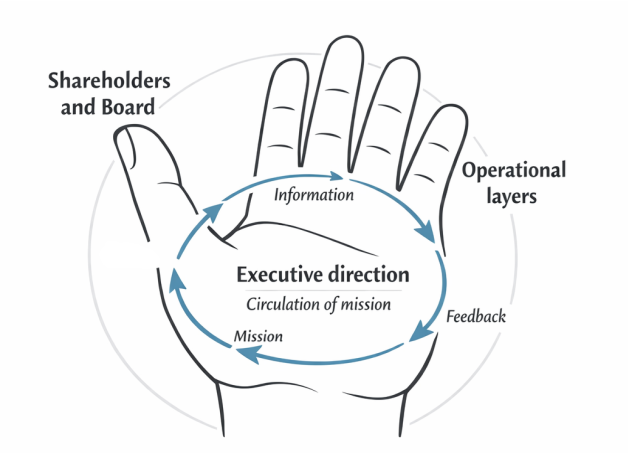
Fig. 4: Governance metaphor figure: Hand and “pump”.
This image comes closer to an interdependent organization. Leadership is not above the others but connects them. One of its essential functions is to circulate the mission and the values, and to support collaboration between all actors. I appreciate this image because it bridges well with the interdependent circles model that makes interdependence even more visible.
9.3 Who sits where in the circles
In a mission-centered model, the mission stands at the center. The first circle around it is leadership. Around that, a wider concentric circle includes shareholders and all other actors, each gravitating in relation to the mission.
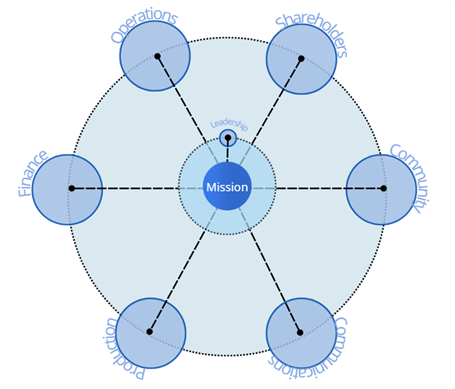
Fig. 5: Who sits where: Different contributions; shared dependence.
In this representation, no person occupies the middle, because the mission is what brings the organization together. Leadership is there as guardian and communicator of that mission. All other actors, including shareholders and domain-specific leaders, collaborate with one another and with leadership whenever alignment with the mission is required.
This image also helps communicate the equivalent importance of investors and workers. Shareholders contribute capital. Workers contribute their work. If either contribution is removed, the organization cannot exist.
10. Mini-centers, divisions, and inter-organizational interdependence
Until now, I have described a model for one organization. But we can extend the question. What happens between organizations? And what happens when one organization grows and begins to include subdomains?
The interdependence model can scale. Divisions can be understood as mini-centers that remain connected to a shared center. I sometimes imagine star systems gravitating around a galactic center. Each organization has its own mission at the core. And several organizations could, in turn, gravitate around a larger, perhaps more abstract mission. Connections then form between domains across these centers.
In that sense, the interdependence model can support a vision of inter-organizational interdependence. It helps us see centers of gravity within organizations and also the relationships that form between them.
10.1 Center plus mini-centers
If we look at the idea of an expanding organization, we can imagine divisions emerging with their own rhythms, constraints, and fields of expertise. In a sense, they would have their own sub-mission, a kind of zoomed-in mission-centered geometry that still gravitates around the larger mission.
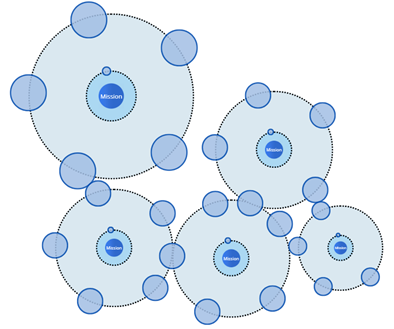
Fig. 6: Mini-centers interpret the mission locally; leadership holds coherence across mini-centers.
Here we can recognize managers who, while working with leadership to remain aligned with the broader mission, also articulate and develop a specific mission for their division together with their team. That division becomes a mini-center. This mini-center does not replace the shared center. It carries a localized responsibility for mission coherence within its own domain.
Like in a living organism, each system has its own mission, with specific organs playing unique roles within that system, and yet each system still serves the larger mission of the organism.
This is how we can recognize distributed leadership, not as a lack of control, but as a true embodiment of interdependence, in a similar way to what happens in an ecosystem, where each species acts according to its own rules and behaviors, yet in balance with the whole, so that harmony translates into what scientists call natural productivity.
That is the way Fraley describes distributed leadership, as something that “uses clear processes for decision-making rather than personal discretion” (Fraley, 2026b). That description is useful when considering the prepared adult environment. It needs to be a system of shared agreements that makes responsibility possible beyond the presence of one particular person.
It also tells us something about the shared center and leadership. Practically, it means leadership holds responsibility for coherence across mini-centers. By protecting and communicating the mission, it maintains common language, shared priorities, and aligned standards where they matter.
On their side, mini-centers carry responsibility for local adaptation. They interpret the mission within a specific reality of work.
We can see here the reciprocity in this relationship, and the need for ongoing circulation of information and regular moments when the mission is revisited together.
10.2 Extending circles beyond one organization
On the subject of external circles, we all know that organizations never act alone. They work with clients, suppliers, partners, regulators, students, participants, communities, and others. Each of these entities has its own center, its own mission, and some even have their own internal circles.
With the interdependent model, inter-organizational coordination can be understood as contact between centers when missions find alignment. This representation also helps articulate boundaries and more easily identify alignment with other organizations. We can coordinate without absorbing. We can collaborate without confusing roles.
Fig. 7: Connected centers (organizations in relationship).
This echoes something many entrepreneurs already know: partnership requires clarity about what each party holds as non-negotiable, what is adaptable, and what belongs to consultation.
10.3 Internal and external “radiance”
For Michaël, an interdependent model must also carry an image of radiance (Veilleux, 2026). Not in the sense of promotion or influence as a goal, but as something that naturally emerges when individuals and organizations embody interdependence. He described how other organizations connected to his began to grow curious about the way they were organizing themselves and moving forward. In some cases, alignment emerged. He also observed how his practices influenced those of his clients.
This is how he describes external radiance: a natural diffusion of an organizational philosophy through example. Internal radiance, on the other hand, spreads through the quality of leadership. How do we care for the members of our organization? What form does that care take? Is it expressed through control and surveillance, or through recognition and support?
For Michaël, this includes rhythms that allow recovery, visibility of workload without shaming, and norms that make it acceptable to name limits early. Above all, it includes trust. These are necessary conditions that can be intentionally prepared to support contributive independence and, therefore, interdependence.
11. Visual language and the psychology of forms
I introduced the idea of mandala-like geometry as cultural support for interdependence in section 4.2. In 4.3, I described how language functions as structure. In this chapter, I want to narrow the lens. I want to explore how forms and diagrams train perception and behavior in ways that words alone cannot.
We often think organizations are shaped by policies, roles, and processes. They are also shaped by the images people return to when they explain how things work. Under stress, teams rarely reason in long sentences. They rely on images. And the more familiar an illustration is, the more it becomes a reflex in difficult moments.
11.1 When the pyramid returns, the reflexes return
The traditional pyramid image is resilient because it is simple and familiar. It offers a clear orientation: up and down, above and below, permission and compliance. For many of us, it echoes how we were educated and how school was organized.
In an earlier section, I described how vertical language trains vertical expectations. Here, I would like to look at the behavioral profile that often accompanies this pyramid imagination, even in organizations that aim to be collaborative.
When the pyramid is the background image, people commonly learn to:
- Look upward for safety and permission. Initiative becomes risky until it is validated by someone “above.”
- Manage appearance toward authority. Work starts to include an invisible layer of “how will this be perceived,” which can gradually replace “what does the mission require.”
- Treat disagreement as a relational threat. A difference of perspective is heard as opposition to authority rather than as information about complexity.
When the pyramid is the background image, its vocabulary comes with it, almost as a small extension of the form itself. Words like “escalate,” “report up,” “sign off,” “approve,” and “chain of command” carry the same spatial logic: responsibility is imagined as moving upward, and protection as living near authority. Repeated often enough, this language becomes part of the inner map people use under stress. Initiative waits for permission, boundaries feel charged, and the safest move can seem to be staying in one’s lane.
We should not see these as moral failures, because they are learned adaptations to an implied structure. What we can do is ask what new image could train us toward a different paradigm.
11.2 What circles do that pyramids cannot
I have already explained how the circles model in section 4.1 clarifies domains of responsibility and how this relates to proximity to the mission. Here, I am looking at the psychological effect of this geometry. I am asking how it changes what feels like figure and what feels like background.
In a pyramid, authority feels like the figure. The mission becomes secondary, almost like a slogan attached to the structure. In a mission-centered geometry, the mission becomes the organizing center. Authority then appears as a function in service of coherence.
Imagine how different it is when the underlying question in every decision becomes, “what does the mission require?”, rather than “who needs to approve this?” In my day-to-day work with teams, circles help me locate responsibility through consequences and through the work itself, because when decisions stay close to the work, consequences are visible. But when decisions are pulled upward, consequences become abstract and responsibility starts to feel like performance.
11.3 What about triangles?
Circles help locate domains in relation to mission. Sometimes a team also needs a form that makes balance visible.
A triangle can be useful when a situation keeps collapsing into a two-sided tension. It invites a different question: what is the third force that must be held at the same time for the system to stay coherent? For example, a decision may need to hold mission coherence, care for people, and operational constraints together. When that third point is named, the tension often diffuses. The conversation becomes less about who is right, and more about what needs to be balanced. This remains an area that would benefit from more thought.
12. Discussion: strengths and limits
I believe frameworks are useful when they make abstract ideas clearer and when they help people act with more coherence. This is what the interdependence model could offer. It proposes a way to see, a way to name, and a way to prepare conditions for organizations that serve the mission more fully and also serve their members more responsibly.
Here, I will try to summarize some key elements of my reflections and list some of the limits and questions that still feel open to me.
Interdependency model keys:
- Power as exercised with others in service of mission. We look at power as a function exercised in relationship and oriented toward purpose. Leadership is seen as stewardship of conditions, coherence, and the protection of dignity. It is also about guardianship of the mission itself by holding its meaning, keeping it alive in the team and in the work, and communicating it.
- True responsibility. Responsibility becomes real when domains are visible and clearly defined. Accountability then follows, because decisions can be evaluated through mission coherence and consequences for the work, rather than through loyalty or personality.
- Structural clarity that locates value in contribution. The model makes visible how language, imagery, and organizational form shape perception. By organizing work around domains of responsibility and proximity to mission, it anchors value in contribution and coordination rather than in rank. This shift helps reduce bias patterns that tend to privilege visibility, proximity to power, or similarity to those already recognized.
Limits and open questions
- Shareholder place without sacralizing money. Governance and ownership carry legal authority and real risk. How can shareholders and boards hold fiduciary responsibility while remaining accountable to mission as the true center? How can property be respected without becoming the hidden source of human value?
- Practices that support movement from level 2 to level 3. Many organizations can sustain functional reliability. Fewer sustain inspired engagement. What concrete practices reliably support the developmental movement from compliance-based contribution toward inner adhesion to mission?
- Integrity made observable without surveillance. Integrity is a condition of trust and functionality, yet attempts to measure it can become controlling. What practices make integrity discussable and visible, while preserving dignity and avoiding monitoring culture?
13. Conclusion: Responsibility and Interdependence in Organizations
An important point of my paper reflects Montessori’s developmental theory that responsibility develops from independence and reaches its fuller expression through interdependence. We all know that independence gives the capacity to act, but interdependence gives meaning to these actions through relationship, consequences, and, more importantly, contribution.
I also argue that organizations follow developmental patterns in terms of members’ engagement, and that many organizations are stuck at the second stage, which relies on the power and energy of leadership alone. If they cultivate responsible freedom through distributed responsibility, they can see more genuine initiative, expect consultation, protect dignity, and keep the mission as the collective reference point.
The Montessori interdependence model I propose here for organizations has a mission-centered geometry that invites a shift in attention. We move from status to function, from personality to prepared conditions, and from control to stewardship. I suggest a framework that supports sustainability, not only in theory but in practice.
In the same way, in my classroom, to allow children to develop true responsibility, I had to prepare conditions for contributive independence and workable interdependence. This allowed me, eventually, to withdraw my energy so that the community could come to life and accomplish its mission.
I am not talking about a model that ensures harmony. Like in the classroom, conflicts and tensions are a normal part of a human community. What an interdependent framework changes is how power circulates within these tensions. When the imaginary is less about position and more about coherence and mission, then limits become less about asserting power and more about protecting the container that makes shared work possible.
I also believe that understanding organizations developmentally allows us, as we do in Montessori education, to see things in movement, always keeping in mind the conditions that need to be prepared to rise to the next level. A true Montessorian learns to observe without bias or prejudice, in order to discern, without judgment, what needs to be done to allow a person or a community to move to the next phase of development.
It requires acceptance and humility. Acceptance, because condemning and judging a level of development imprisons us in labels and statuses. And we understand that different levels of development require different types of leadership. Humility, because true leadership understands the value of creating communities that do not depend primarily on our presence and involvement.
Humility also, because in the end, an interdependent model requires us to understand our individual contribution as well as our organization’s contribution in interdependence with others. It requires us to understand our place in the cosmos as a contribution to a greater whole.
In Michaël’s words (Veilleux, 2026): “The real game is not business. The real game is human formation through meaningful work, in relationship, across time.”
If Montessori has something to offer adult organizations, it may be this orientation. We become more fully human as we learn to carry freedom as responsibility, and responsibility as contribution within interdependence. An organization that takes this seriously does more than prosper. It becomes a place where adults practice a way of living that the future will require.
References
Author. (2026). Anonymous sources.
Bridges, W., & Bridges, S. (2017). Managing transitions: Making the most of change (4th ed.). Nicholas Brealey Publishing.
Brown, B. (2018). Dare to lead: Brave work. Tough conversations. Whole hearts. Random House.
Dumas, Janick (2026, February). Interview with Allan Nguyen [Interview transcript]. Unpublished manuscript.
Fraley, Jess (2026a, February 14). Letter to the board of directors [Unpublished letter]. Personal Communication.
Fraley, Jess (2026b, February). Exploring a distributed organizational structure [Unpublished handout]. Personal Communication.
Hicks, D. (2018). Leading with dignity: How to create a culture that brings out the best in people. Yale University Press.
Laloux, F. (2014). Reinventing organizations: A guide to creating organizations inspired by the next stage of human consciousness. Nelson Parker.
Montessori, Maria. (2007a). The absorbent mind. Montessori-Pierson Publishing Company.
Montessori, Maria. (2007b). Education for a new world. Montessori-Pierson Publishing Company.
Nguyen, A. (2025, November 17). Education for peace: Cultivating an interdependent mindset through Montessori’s cosmic perspective. Paideia Nova. https://www.paideianova.org/education/2025/11/17/education-for-peace-cultivating-an-interdependent-mindset-through-montessoris-cosmic-perspective/
Veilleux, Michaël (2026, February). Interview with Allan Nguyen [Interview transcript]. Unpublished manuscript.