
Allan Nguyen, Association Montessori Internationale, 6–12 Trainer
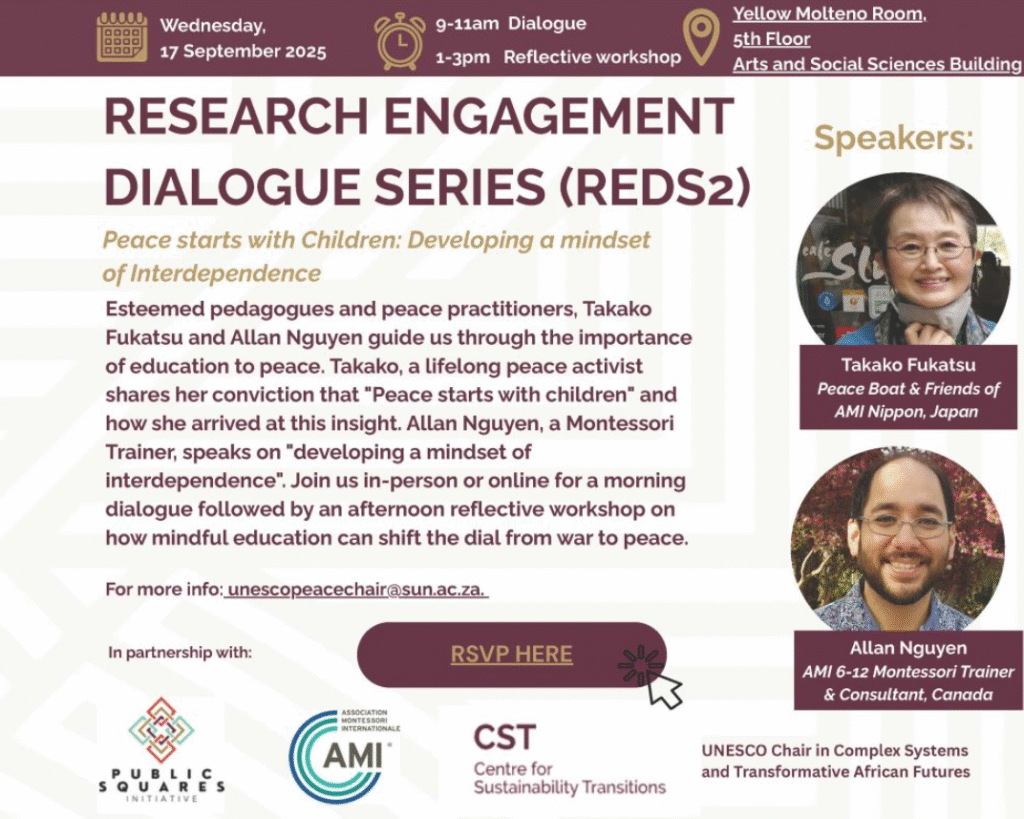
This conference paper grew out of a public dialogue in the Research Engagement Dialogue Series at Stellenbosch University on 17 September 2025, hosted by the UNESCO Gandhi–Montessori–Luthuli Chair on Education for Peace and Transformative Solidarity. The session was opened by Alain Tschudin and Takako Fukatsu. Building on Alain Tschudin’s reflections on peace as lived practice in communities, and on Takako Fukatsu’s testimony of peace beginning with the child, this paper explores how Montessori’s cosmic perspective cultivates the interdependent mindset necessary for peace to take root at scale.

Abstract
Peace can be understood as a developmental achievement that emerges when interdependence is perceived cognitively, affectively, and behaviorally. This paper argues that Montessori’s cosmic perspective provides a coherent pathway from the child’s inner integration to cultural participation and social responsibility. I synthesize core Montessori concepts with evidence from environmental psychology, motivation science, and organizational research to show why belonging, gratitude, hope, and meaningful work function as levers for prosocial behavior. I then sketch a conceptual framework for implementation in South Africa that centers inclusion, shared language, and partnership.
Keywords: cosmic education, interdependence, peace education, ecoliteracy, Ubuntu, Ukama, gratitude, hope, self-determination, psychological safety, Montessori
Introduction
Takako Fukatsu’s talk situated peace where it must begin, in the lived experience of the child. Her memories of the Cambodian refugee camp gave this truth a human weight, showing how a child’s early environment can either nourish or fracture the possibility of inner peace. I extend that starting point by asking how education can scale peace beyond individual children and into the systems they will inherit and shape. The claim is that education for peace means educating for interdependence. This requires a mindset that learns to read relationships in nature and society, to feel a sense of belonging within them, and to act responsibly because of that belonging.
Montessori Foundations for Peace
In Montessori’s language, peace is the fruit of development rather than a decorative ideal. When the environment is prepared, concentration appears, order is internalized, and the personality integrates. Montessori called this normalization[1], and it has a parallel in the unfolding strength of adolescence, where valorization (the adolescent’s discovery of personal worth through meaningful work) becomes service and commitment (Montessori, 2007, 2010). These foundations carry the seed of a social ethic because the child who experiences ordered freedom develops both self-regulation and regard for others.
Empirical work aligns with this head-heart-hands view of learning. A study titled Modelling environmental literacy with environmental knowledge, values and (reported) behaviour found that environmental literacy is best understood as a system that integrates what learners know, what they value, and what they actually do. In other words, knowledge by itself is not enough to mobilize behavior, it must be coupled with felt meaning and practice (Maurer & Bogner, 2020). A classic meta-analysis titled Analysis and synthesis of research on responsible environmental behavior reached a similar conclusion across many datasets, highlighting issue knowledge, action strategies, and a sense of efficacy as consistent predictors of responsible action (Hines et al., 1987). Together these findings suggest a simple design principle for schools: educate understanding, attachment, and efficacy at the same time, not in separate lanes.
Connectedness with the living world also matters. A meta-analysis titled The relationship between nature connectedness and happiness associated a stronger felt bond with nature with higher life satisfaction and positive affect (Capaldi et al., 2014). Experimental work titled The cognitive benefits of interacting with nature showed that even brief exposure to natural settings restores directed attention, the very capacity required for careful work and social grace (Berman et al., 2008). Another meta-analysis, Human connection to nature and proenvironmental behavior, linked greater connection to nature with a higher likelihood of acting in nature’s favor (Whitburn et al., 2020). These findings suggest that regular contact with natural systems should be considered a basic condition for education rather than an optional enrichment.
A Cosmic Perspective, or the Interdependent Mindset
Montessori used the term cosmic education to describe an orientation in which children encounter knowledge through the lens of interdependence – linking ecological laws, human history, and cultural development into a single narrative of life (Montessori, 2010). We introduce interdependencies and universal laws, the idea of cosmic agents and tasks (the roles that every element of nature fulfills in maintaining balance and continuity), and nazione unica, or ‘single nation of humanity’. We present the human being as a conscious worker in a story much larger than personal success. Method matters. We move from whole to parts and from origins to emergence so learners enter a living narrative rather than a list of fragments (Montessori, 2010). This orientation is not sentimental. It is a disciplined way of seeing systems.
Experiences of belonging tend to generate a sense of responsibility, as learners come to see themselves embedded in networks of mutual dependence. The interdependent mindset reads the threads that connect food, water, energy, work, and waste. It recognizes human interdependencies from classroom micro-economies to global exchange.
Montessori’s phrase the unconscious in history (Montessori, 1948) refers to the countless, often unseen contributions through which living beings — plants, animals, and humans alike — shape the earth and human destiny. Inviting children to perceive that fabric is an invitation to see their own potential role in it. Montessori called supramind the collective intelligence of humanity, created when individual minds link their efforts across time and place. From this arises supranature, the human-created layer of tools, institutions, and environments that extends and transforms the natural world.
Certain emotions help people turn belonging into action. Research on gratitude shows that it can tilt behavior toward cooperation even when helping is personally costly. In Gratitude and prosocial behavior: Helping when it costs you, participants who felt gratitude were more likely to help at a cost than those who felt only general positivity (Bartlett & DeSteno, 2006). Gratitude also stretches in time. The role of gratitude in motivating intergenerational environmental stewardship showed that gratitude for benefits received from the past increases people’s sense of duty to those who will come after, including willingness to act for the environment (Syropoulos et al., 2020). Hope adds a second lever. In Hope theory: Rainbows in the mind, hope is described as agency plus pathways, meaning the will to move and the skill to map routes and re-route when blocked (Snyder, 2002). Together, gratitude and hope support prosocial persistence, the quiet stamina that peace requires.
African thought brings a resonant vocabulary. Ubuntu is often translated as I am because we are. Ukama extends the sense of kinship to land and life. Enrique Salmón’s article Kincentric ecology: Indigenous perceptions of the human-nature relationship names the view that humans and the more-than-human form one family of kin, which implies reciprocity rather than extraction (Salmón, 2000). Kim-Pong Tam’s Gratitude to nature work suggests that feeling grateful to nature can motivate both intentions and real acts of care (Tam, 2022). These ideas need to be engaged with care and humility, yet even brief attention to them helps learners see why belonging naturally grows into stewardship.
Preparing Adults as Catalysts of Peace in Education
If education for peace means education for interdependence, then adults are catalysts. Montessori asked for a threefold preparation. Intellectual preparation gives philosophical clarity and a map of development. Scientific preparation develops observation, method, and evidence-guided practice. Spiritual preparation shapes the inner stance children sense immediately: humility, patience, mastery of will, and service to life (Montessori, 2007, 2010).
Practical levers can support that transformation. Awe opens the heart to vastness and interconnection. Origin stories organize meaning. Nature experiences ground the senses. Service links knowledge to real needs. Reflection consolidates learning. Mentorship steadies growth. Motivation science clarifies the conditions that help adults sustain this work. Self-determination theory and the facilitation of intrinsic motivation, social development, and well-being identifies autonomy, competence, and relatedness as basic needs that, when met, foster vitality and contribution (Ryan & Deci, 2000). Learning cultures matter too. Psychological safety and learning behavior in work teams shows that teams learn more when people feel safe to speak up and take interpersonal risks (Edmondson, 1999). Burnout is the cautionary edge. Job burnout defines a syndrome of exhaustion, cynicism, and inefficacy born of chronic stressors without the right supports (Maslach et al., 2001). Finally, Awe, the small self, and prosocial behavior finds that awe can reduce self-focus and increase helping, a reminder to design for awe on purpose in adult formation as well as with children (Piff et al., 2015).
Education for Peace in Practice: a Conceptual Sketch for South Africa
The vision of peace through an interdependent mindset is not only theoretical. In South Africa, it is being carried into practice through First Children, the Association Montessori Internationale’s training and development organization for the country. First Children’s ten-year strategic plan (2025–2035) provides a living example of how educational philosophy can be embedded in structures that serve diverse communities. The initiatives described here are drawn from that plan, not to disclose operational minutiae, but to illustrate how the principles discussed above are being translated into concrete mechanisms.
The plan is structured around five strategic impacts: reaching all communities, strengthening and unifying the Montessori community, elevating the quality of practice, raising public awareness, and valorizing culture and diversity. Three flagship initiatives, each tightly linked to these impacts, illustrate how an interdependent mindset can be cultivated at scale.
1) The Montessori Core Principles (MCP) Course: Shared Language
MCP is a 120-hour certificate course that presents Montessori’s foundations across the four planes of development. It serves as a philosophical spine for adults across roles and levels, ensuring that interdependence is not an optional theme but the shared framework for thinking and collaboration. By including not only teachers but also administrators and community leaders, MCP broadens participation and creates coherence across the ecosystem.
2) The First Children Interdependency Program (FCIP): Practice Embedded in Training
The FCIP is a framework that will be integrated systematically into all AMI diploma courses in South Africa. Its purpose is to help adult learners cultivate an interdependent mindset. Through guided study, reflection, activities and practical projects, adults are invited to link educational practice with ecological responsibility and social solidarity. In this way, Montessori’s cosmic perspective is not left abstract: it is internalized as a professional habit and carried into the classroom and community.
3) The Partnership Program: Solidarity Instead of Hierarchy
This program structures a triad around each diploma student: the training course, a practicing school, and an experienced AMI diploma holder designated as a course partner. The model ensures that learning is grounded in real classroom practice, while also building a culture of reciprocity. The partner preparation includes practices and skills that move beyond traditional hierarchical models—such as consulting, mentoring, or coaching—toward relationships of partnership, where the dignity of the student is nurtured and contributions are reciprocal. In this way, the program itself models the interdependent mindset it seeks to develop. Each course partner commits to offering part of their mentoring hours free of charge in underserved communities. This makes equity a built-in feature of the training system rather than an optional add-on.
Visible Inclusion as a System Priority
Beyond these three engines, the plan treats cultural and linguistic representation as a condition of quality. Diploma students and trainers co-create language stories, history timelines, and other materials in South Africa’s major languages, building toward complete national sets. Key Montessori principles will be published in multiple languages in a free public library. Recognition pathways with universities and the National Qualifications Framework are pursued so Montessori diplomas gain formal status. These measures ensure that Montessori education does not remain an enclave for the privileged, but speaks with and for the nation’s diversity.
Why This Matters in a Paper on Peace
Peace, understood as the cultivation of an interdependent mindset, requires more than classroom practice. It requires systems that prepare adults, include diverse cultures and languages, and extend solidarity to underserved communities. The MCP course builds a shared philosophical foundation. The FCIP ensures that adult formation links pedagogy to ecological and social responsibility. The Partnership Program anchors solidarity in the daily practice of training and mentoring. Taken together, these initiatives show how Montessori’s vision of peace can inform institutional design in a national context.
Ethics Note
Working with underserved communities and with cultural narratives requires care. Co-creation, not extraction, should be the norm. That includes transparent aims, shared authorship where appropriate, and a willingness to slow down when community priorities and timelines require it. On the training side, autonomy, competence, and relatedness should be supported for adults as well as children so the work remains humanizing rather than depleting.
Conclusion
Peace that begins with the child can scale when adults and systems learn to live interdependence. Montessori’s cosmic perspective offers a coherent way to see connections, feel belonging, and act with responsibility. The science reviewed here is not an external add-on; it clarifies why gratitude, hope, connectedness with nature, and meaningful work reliably move people toward care for others and for the living world. In South Africa, Cambodian refugee camps, and elsewhere, the path forward is to braid shared language, threaded practice, and partnership with visible inclusion. The seed is in the child. The garden is ours to tend together.
References
Bartlett, M. Y., & DeSteno, D. (2006). Gratitude and prosocial behavior: Helping when it costs you. Psychological Science, 17(4), 319–325. https://journals.sagepub.com/doi/abs/10.1111/j.1467-9280.2006.01705.x
Berman, M. G., Jonides, J., & Kaplan, S. (2008). The cognitive benefits of interacting with nature. Psychological Science, 19(12), 1207–1212. https://journals.sagepub.com/doi/abs/10.1111/j.1467-9280.2008.02225.x
Capaldi, C. A., Dopko, R. L., & Zelenski, J. M. (2014). The relationship between nature connectedness and happiness: A meta-analysis. Frontiers in Psychology, 5, 976. https://pmc.ncbi.nlm.nih.gov/articles/PMC4157607/
Edmondson, A. (1999). Psychological safety and learning behavior in work teams. Administrative Science Quarterly, 44(2), 350–383.
Hines, J. M., Hungerford, H. R., & Tomera, A. N. (1987). Analysis and synthesis of research on responsible environmental behavior: A meta-analysis. The Journal of Environmental Education, 18(2), 1–8. https://scholarworks.uni.edu/facpub/4717/
Maslach, C., Schaufeli, W. B., & Leiter, M. P. (2001). Job burnout. Annual Review of Psychology, 52, 397–422. https://pubmed.ncbi.nlm.nih.gov/11148311/
Maurer, M., & Bogner, F. X. (2020). Modelling environmental literacy with environmental knowledge, values and reported behaviour. Studies in Educational Evaluation, 65, 100863. https://www.sciencedirect.com/science/article/pii/S0191491X20301115
Montessori, Maria (1948). The unconscious in history. The Montessori Magazine (Association Montessori Internationale–India), April. [Reprinted in Around the Child (1965/66) and AMI Communications, 2/3, 1973].
Montessori, Maria (2007). The formation of man (Montessori-Pierson ed.). Montessori-Pierson Publishing Company.
Montessori, Maria (2010). To educate the human potential (Montessori-Pierson ed.). Montessori-Pierson Publishing Company.
Montessori, Maria (2019). Education and peace (Montessori-Pierson ed.). Montessori-Pierson Publishing Company.
Piff, P. K., Dietze, P., Feinberg, M., Stancato, D. M., & Keltner, D. (2015). Awe, the small self, and prosocial behavior. Journal of Personality and Social Psychology, 108(6), 883–899. https://pubmed.ncbi.nlm.nih.gov/25984788/
Ryan, R. M., & Deci, E. L. (2000). Self-determination theory and the facilitation of intrinsic motivation, social development, and well-being. American Psychologist, 55(1), 68–78.
Salmón, E. (2000). Kincentric ecology: Indigenous perceptions of the human-nature relationship. Ecological Applications, 10(5), 1327–1332. https://doi.org/10.1890/1051-0761(2000)010[1327:KEIPOT]2.0.CO;2
Snyder, C. R. (2002). Hope theory: Rainbows in the mind. Psychological Inquiry, 13(4), 249–275. https://www.jstor.org/stable/pdf/1448867.pdf
Syropoulos, S., Watkins, H. M., Shariff, A. F., Hodges, S. D., & Markowitz, E. M. (2020). The role of gratitude in motivating intergenerational environmental stewardship. Journal of Environmental Psychology, 72, 101517. https://climateaging.bctr.cornell.edu/for-researchers/publications-database?091cf7cd_page=2
Tam, K.-P. (2022). Gratitude to nature: Presenting a theory of its conceptualization, measurement, and effects on pro-environmental behavior. Journal of Environmental Psychology, 79, 101754. https://kimpongtam.com/research
Whitburn, J., Linklater, W., & Abrahamse, W. (2020). Meta-analysis of human connection to nature and proenvironmental behavior. Conservation Biology, 34(1), 180–193. https://pubmed.ncbi.nlm.nih.gov/31251416/
[1] In Montessori’s language, “normalization” does not mean becoming ordinary or conforming to norms. It refers to a process of inner harmony in the child, when concentration, love of work, self-discipline, and social balance appear as a natural outcome of freedom in a prepared environment.