
Written by Allan Nguyen during the AMI International Trainers’ Meeting in Chennai, October 2025. During the week’s program, participants were graciously invited to visit the historic campus of the Theosophical Society at Adyar on October 29, a place deeply intertwined with Maria Montessori’s years in India and the evolution of her philosophical and educational perspective.
Our visit to the Theosophical Society in Adyar felt like a return to a place where history, philosophy, and education are deeply intertwined. The campus, bordered by the river and the sea, holds a natural beauty: banyan trees, sand paths, and old colonial houses hidden under tropical shade. Walking through it, I finally felt in Chennai more than a tourist, but as a member of a group of inheritors of a story that connects the roots of Montessori education in India with a broader spiritual search for unity.
The day before, we had heard Sonal Murali, Director of the Adyar Theosophical Academy, offer an introduction to the Theosophical Society and its vision. Her words gave us a frame through which to see the place and its philosophy: “We are not human beings on a spiritual journey, but spiritual beings on a human journey.” She spoke of transformation as a personal effort, and of education as a path for awakening this inner awareness, themes that resonated deeply with the Montessori understanding of the child as a spiritual builder of humankind, and with the theme of the adult transformation.
The Theosophical Society was founded in 1875 by Helena Blavatsky and Colonel Olcott, and its international headquarters was later established in Adyar in 1882. Its core idea, the unity of all life, shaped the thinking of many reformers of the time, including Annie Besant and Maria Montessori. When the war broke out in Europe in 1939, Montessori, then in India for a lecture tour, could not return home and found refuge here, in the Olcott Bungalow. She lived on the upper floor while the ground floor served as a classroom. It was there, within the grounds of this same Society, that she inaugurated her first training course in India and opened the Montessori school, beginning a decade of work that would transform education across the subcontinent, and deepen her vision of education.
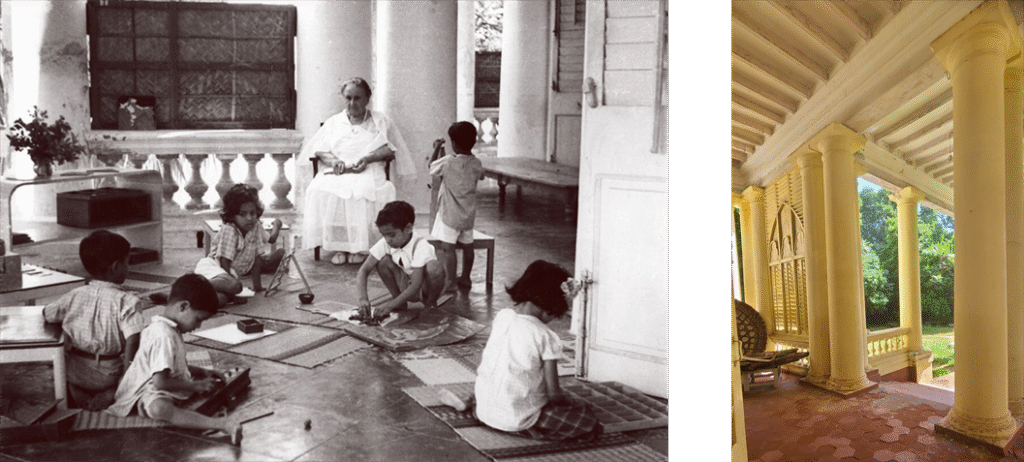
AMI Digital Archives, archives.montessori-ami.org
Standing before the Olcott Bungalow today, we could still recognize the wide verandas and the proportions of the building familiar from the black-and-white photographs of her time in Adyar. To be inside those same rooms was moving. The tiled floors, the old staircases, the light filtering through trees… everything seemed to carry an echo of her presence and the spirit of her work.
From there, we walked to visit the Olcott Memorial School, established originally by Colonel Olcott in 1894 for children from disadvantaged communities. The school still serves this purpose today, offering free education, meals, uniforms, and books to hundreds of children from the nearby fishing and working-class neighborhoods. The atmosphere was joyful and peaceful. Children were playing in the courtyards, others attending lessons in a re-usable eco-building that forms part of what the Society calls its Blue Green Centre, an initiative for environmental awareness and community education. All of this surrounded by beautiful trees, a children-made butterfly garden, a medicinal plants garden, etc.
Though not a Montessori school, the place carried a spirit that felt very close: a deep respect for the child, for nature, and for the interconnectedness of life. The Blue Green Centre, as we learned, is part of the Society’s Adyar Eco Development project. It promotes experiential learning through contact with the natural environment – water, soil, plants, and the cycles of life – ideas that echo Montessori’s Cosmic Education, where the child learns to see themselves as part of the great network of existence. To think about these children caring for their gardens and moving between indoor and outdoor spaces was to witness that same principle lived out, in its own form, across time and context.
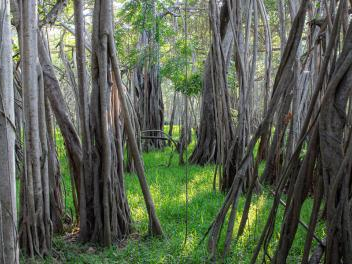
I only wished that during our visit, we could have stopped beneath the Great Banyan Tree, but we just passed by bus. This tree is an immense living symbol of the Adyar campus. The original trunk has since died, but its offshoots have taken root over a vast area, creating a single organism of hundreds of branches and roots: one tree, many lives. It is said to be among the largest in India. Even by just seeing it from the bus window, one could sense why Montessori, who so often spoke of the unity of life and the continuity of the natural world, felt at home here. The tree itself seemed to embody that idea: that growth and renewal are possible even when the original form has passed, and that life finds its way through interconnection.
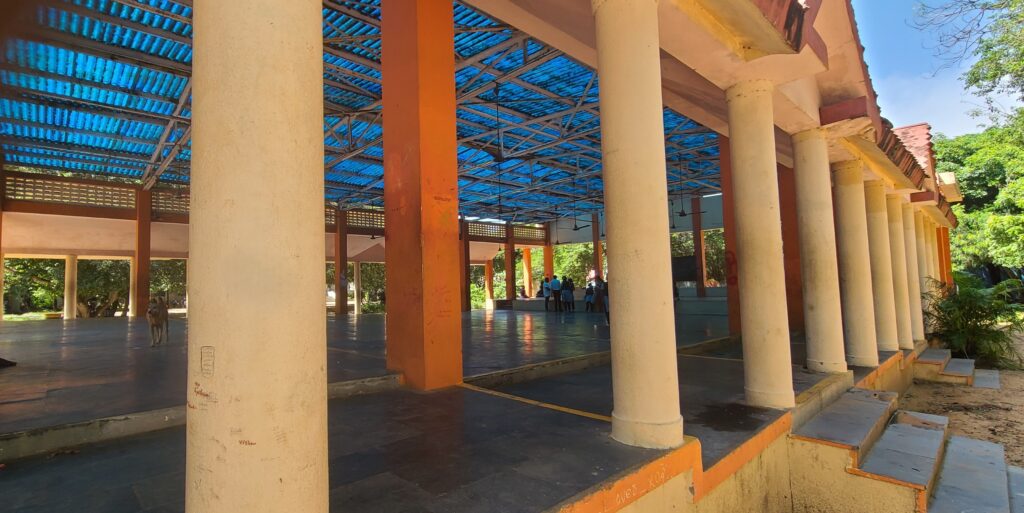
I left the Theosophical Society with gratitude for the words of Sonal Murali that had prepared us, and for the warmth of those who welcomed us in the bungalow and at Olcott School. Among the classrooms, one large covered space caught my attention, open on all sides, filled with light and the hum of children’s voices. It made me think of the time when Maria Montessori herself gave a course in Chennai to nearly three hundred students, and of the immense ripple that must have followed from that gathering. The sight stirred both admiration and a little unease. Today, such large courses have become rare, and I found myself wondering how we might recover that scale of reach. We need so many teachers, yet access remains a challenge. As I walked away, I held on to a small hope: that in the years ahead, we will find ways within AMI to open our training courses to more people without losing their depth and integrity, so that many more children, in many more places, can experience the kind of education that began here.
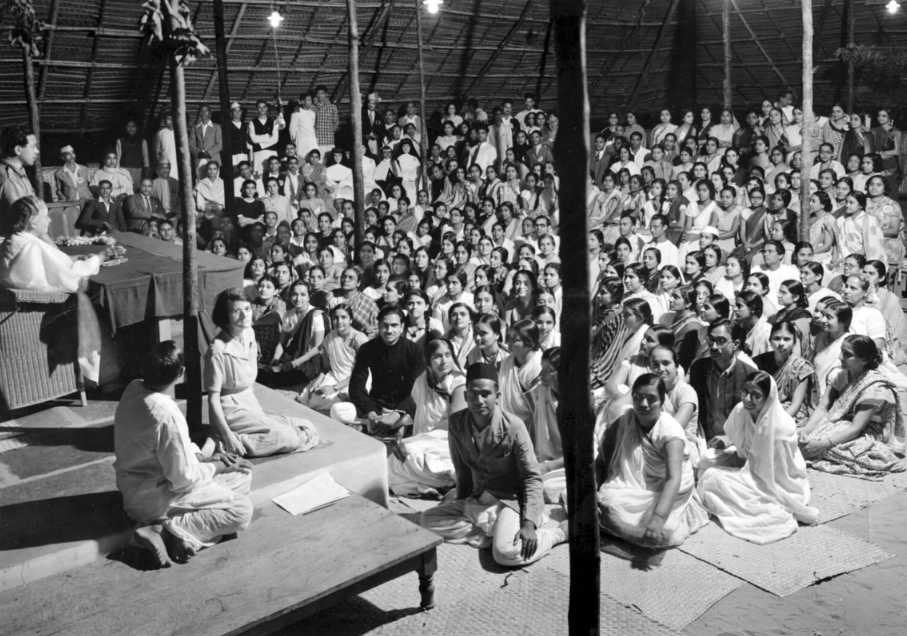
Photograph documenting lectures from the first Montessori teacher training course held in India, conducted at the Theosophical Society headquarters in Adyar in 1939.
AMI Digital Archives, archives.montessori-ami.org.