
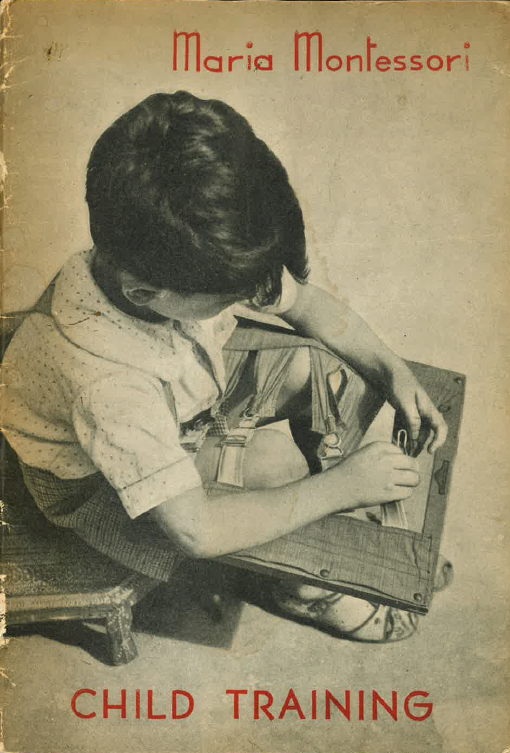
Allan Nguyen, October 2025, Inspired by Maria Montessori’s Madras Talks, 1948
When Maria Montessori spoke over the radio in Madras in 1948, the world was still trembling from the war. Cities were rebuilding, nations were redefining themselves, and humanity was again wondering what kind of world it had created. Montessori’s voice entered that silence not as an expert but as a witness. She spoke to all adults: parents, teachers, citizens. What she asked of them was not instruction but conversion.
She was not interested in improving schools. She was calling for something larger, something moral and spiritual, a transformation of the adult heart.
Her twelve short talks, later published under the title Child Training, unfold with an almost prophetic tone. She begins not by celebrating progress but by revealing its shadow. Humanity, she said, had built a civilization of power and control while neglecting the most creative force on earth, the child.
“The organizer of society,” she wrote, “has been oblivious of his own offspring. The creator of law after law has neglected to do justice to his successor and has left his heir an outlaw.”
For Montessori, this forgetfulness was not simply negligence. It was blindness, a blindness of conscience. The adult had placed himself at the center of everything and had lost sight of life itself. The world he built was brilliant and efficient, but it no longer made space for the small being from whom all humanity begins.
The Birth of a New Conscience
Montessori saw in the child something sacred. She often called the child “the builder of man.” In her Madras Talks, this phrase becomes more than an image; it becomes a mirror in which the adult must recognize his own distortion. The child carries within himself the plan of humanity’s becoming, yet the adult, through ignorance and pride, interferes with that work.
“The social question of the child,” she said, “must go deep into our inmost lives, stirring our conscience and renewing our hearts.”
This is where transformation begins. Not in theory, but in conscience. It requires the adult to see differently, to look at the child not as fragile and dependent, but as the worker of life itself.
Such a change cannot come from knowledge alone. It demands humility.
Adult Pride
Among her most striking images in the Madras Talks is the one found in her reflection on Incarnation. There she exposes what she calls the sin of the adult, pride. She speaks of the adult who, believing himself to be the maker of the child, dares to say, “I will create man in my own image and likeness.”
This pride, she says, blinds us to the truth. The child is not a creation of the adult but of life itself. Our attempts to “form” him are intrusions upon a natural process already in motion.
To overcome this pride is to begin to see life again. Humility, for Montessori, is not submission. It is an act of alignment, of recognizing our place within a larger order. The adult is not the builder of humanity. He is the custodian of the environment where life builds itself.
The Adult as Environment
Throughout the talks, Montessori slowly redefines what it means to be an educator. The adult must cease to be the center and become the atmosphere in which the child’s spirit breathes. The work of the adult is no longer to instruct, but to prepare conditions, physical, emotional, and moral, that support the unfolding of life.
“Our part is to find out what it is that he has got to do…
and provide him with the means he needs for carrying out what he is impelled to by his inner guide.”
The adult becomes part of the child’s environment, as essential and as discreet as air or light. Every gesture, every word, every presence becomes material for the child’s inner architecture. This is what she means when she speaks of the “spiritual preparation of the adult.”
The Consequences of Interference
Montessori speaks with urgency of what happens when adults interfere. Every unnecessary command, every humiliation, every gesture of control leaves a scar. The child’s development follows an inner plan, but when the adult distorts it, the child adapts by withdrawing, by disguising himself, by deviating from his own nature.
She calls these wounds “deviations.” They are not only psychological; they are moral. Each deviation is a fracture in the harmony of life, a small echo of a broken civilization. “He who touches the child,” Montessori says, “touches at its most sensitive point, something rooted in the remotest past, something that reaches out into the farthest future… One who touches a child touches the delicate vital spot where all decisions centre, from which all may be renewed.”
To respect the child’s inner plan is therefore a form of justice. It is an act of peace.
From Power to Service
As the series progresses, Montessori’s tone becomes more hopeful. She describes the possibility of a new relationship between adult and child, one founded on respect and cooperation. She calls the conflict between them a “war,” a struggle of wills that has lasted for centuries. Peace, she says, will come only when the adult renounces his weapons.
The transformation she describes is a reversal of power. The adult who once commanded now serves. The adult who once imposed now removes obstacles. True guidance begins when the adult acts from reverence rather than authority. The child is the teacher of love and humility, he teaches us to be patient and to admire the world.
Through this service, the adult discovers something that resembles redemption. The child becomes not only the builder of humanity but also the healer of the adult. To serve the child is to rediscover one’s own humanity.
The Spiritual Work of Adulthood
A. M. Joosten, who worked closely with Montessori in India, would later describe this process as a conversion. “It is we who have to be converted” he wrote, “in our attitude and with regard to our real task concerning the child.” He adds: “Love, in order to fulfill its function in human life, is in need, like everything that belongs to the human personality of education.” There is usually no lack of love from adults toward the child, but intelligent love is what is missing.”
The adult’s transformation is therefore an education of love. A slow union of connection and understanding. To love the child truly is to study him, to understand his needs, to act with self-control and trust. It is also to love oneself enough to change.
This is not a sentimental process. It demands discipline and courage. It asks the adult to unlearn pride, to let go of the need to control, to observe with humility, and to serve with intelligence.
The Spiritual Work of Adulthood
The Madras Talks end with a phrase that frequently serve as a motto for Montessori education.
“Help me to help myself.”
It is the child’s need, but also the adult’s. It carries the essence of education as a shared movement toward freedom. The child asks for the space to grow; the adult asks for the grace to see.
To help the child, the adult must first help themselves, to grow in awareness, to purify intention, to reconcile knowledge with love. This is what Montessori meant when she said that education must begin with the adult. The child does not need to be improved. It is we who must awaken.
The Renewal of Humanity
In these Madras talks, Montessori widens the horizon of education. She reminds her listeners that the child is not only a promise for tomorrow but the foundation of peace. The transformation of the adult is, in the end, a preparation for the transformation of civilization itself.
This powerful idea holds the heart of her message. To see the child clearly is to see humanity as it could be: connected, creative, and whole. The world can only change when adults recover this vision.
The transformation of the adult is therefore not an educational reform. It is a form of rebirth. A reach for life.
To stand beside the child in support.
To protect what is growing.
To let life do its work.
That is the beginning of a new world.
References
Joosten, A. M. (1971). The spiritual preparation of the adult. Indian Montessori Training Course.
Montessori, M. (1948). Child training. Madras: The Theosophical Publishing House.